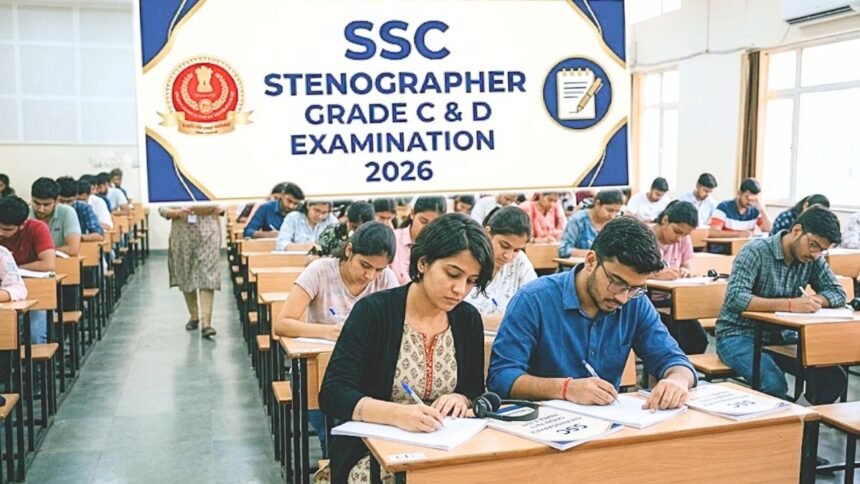
SSC Stenographer Grade C & D Examination 2026: Notification, Exam Date, Vacancies, Eligibility & Selection Process
The Staff Selection Commission (SSC) has released the official notification for the SSC Stenographer Grade ‘C’ & ‘D’ Examination 2026, opening up a fresh round of recruitment for candidates who want to build a career as a government stenographer. The Computer-Based Examination (CBE) is officially scheduled to take place between July and August 2026, and the online application process, which ran from 24 April to 15 May 2026, has already concluded.
With a revised total of 1,170 vacancies now available across multiple central government ministries and departments, this recruitment cycle has become one of the most closely watched SSC exams of the year. If you applied for this exam or are still weighing whether to prepare for the next cycle, here is everything you need to know about the schedule, eligibility criteria, exam pattern, and selection process.
SSC Stenographer 2026: Quick Overview
The SSC Stenographer Grade ‘C’ & ‘D’ Examination is conducted every year to recruit candidates for stenographer posts in various central government ministries, attached and subordinate offices, and statutory bodies. Grade ‘C’ posts fall under the Group ‘B’ (Non-Gazetted) category, while Grade ‘D’ posts are classified under Group ‘C’. Both posts require candidates to possess strong stenography skills in addition to meeting the standard educational eligibility.
This year’s cycle has seen the vacancy count revised upward to 1,170 posts, up from the initially notified figure, reflecting steady demand for stenographers across government departments. The recruitment process consists of two major stages — a Computer-Based Test (CBT) followed by a qualifying Skill Test in stenography — before candidates move on to document verification and final selection.
Key Examination Schedule
Candidates preparing for or tracking this recruitment cycle should keep the following dates in mind:
Notification Release Date: 24 April 2026
Online Application Window: 24 April 2026 to 15 May 2026
Application Correction Window: 20 May 2026 to 21 May 2026
Computer-Based Test (CBT) Date: July – August 2026
Skill Test Date: To be announced after CBT results are declared
The exact CBT dates, along with exam city intimation slips and admit cards, are expected to be released by SSC closer to the examination window. Candidates are advised to keep checking the official SSC website (ssc.gov.in) regularly, since the Commission typically issues these documents only a few days before the actual test dates.
Eligibility Criteria
Educational Qualification
Candidates applying for either grade must have successfully passed their 12th standard (Intermediate) examination from a recognized educational board. This qualification must be obtained on or before 1 August 2026, which is also the reference date used for calculating the age limit. Candidates who cannot furnish proof of having cleared their 12th standard by this date risk cancellation of their candidature at the verification stage.
Age Limit and Post-wise Breakdown
The age limit for both posts is calculated strictly as on 1 August 2026. The two posts differ meaningfully in terms of classification, age bracket, and the stenography speed required:
| Post Profile | Classification | Age Limit (As on 01.08.2026) | Dictation Speed Requirement |
|---|---|---|---|
| Stenographer Grade ‘C’ | Group ‘B’ (Non-Gazetted) | 18 to 30 years (born between 02.08.1996 and 01.08.2008) | 100 words per minute (WPM) for 10 minutes |
| Stenographer Grade ‘D’ | Group ‘C’ (Non-Gazetted) | 18 to 27 years (born between 02.08.1999 and 01.08.2008) | 80 words per minute (WPM) for 10 minutes |
Standard age relaxation rules apply for reserved categories: candidates belonging to SC/ST get a 5-year relaxation, while OBC candidates are entitled to a 3-year relaxation over the upper age limit. Additional relaxations are applicable for PwBD, Ex-Servicemen, and other categories as per government norms.
Nationality
Applicants must be Indian citizens, or fall under specific categories of persons of Indian origin who have migrated from certain countries with the intent to permanently settle in India, subject to the necessary eligibility certificate being issued by the Government of India where applicable.
Vacancy Details
The current cycle has seen the vacancy figure revised to 1,170 posts in total, split across Grade ‘C’ and Grade ‘D’ positions, with Grade ‘D’ accounting for the significantly larger share of the intake. These posts are spread across various central government ministries, departments, attached and subordinate offices, and statutory bodies. Category-wise (UR, SC, ST, OBC, EWS) vacancy distribution is typically released separately by the Commission and may be subject to further revision as departments finalize their requirements closer to the selection stage.
Stenographer Grade ‘C’ candidates, once selected, are generally posted within the Delhi region, whereas Grade ‘D’ postings are distributed more widely across ministries and departments in different states and union territories.
Selection Process & CBT Exam Pattern
The SSC Stenographer 2026 recruitment cycle consists of two major phases:
Phase 1: Computer-Based Test (CBT)
The written examination is conducted online and consists of objective-type multiple-choice questions, with a total time duration of 2 hours. The paper is divided into three sections:
English Language & Comprehension: 100 questions / 100 marks
General Intelligence & Reasoning: 50 questions / 50 marks
General Awareness: 50 questions / 50 marks
That brings the total to 200 questions worth 200 marks. A negative marking of 0.25 marks is deducted for every incorrect attempt, so candidates need to approach the paper with a degree of caution rather than attempting every question blindly. Questions are set bilingually in Hindi and English, except for the English Language & Comprehension section. The Commission has also introduced sectional timings for this exam — 30 minutes each for the first two sections and 60 minutes for the third — meaning candidates cannot freely shift time between sections during the test.
To move forward in the process, candidates need to clear both the sectional and overall CBT cut-offs, which vary by category: typically around 30% for UR candidates, 25% for OBC/EWS, and 20% for other reserved categories, though the Commission notifies exact qualifying marks after the exam.
Phase 2: Shorthand Skill Test
Candidates who clear the CBT cut-offs advance to the Skill Test, which is entirely qualifying in nature — meaning it does not contribute to the final merit ranking but must be cleared to remain in the selection process. In this stage, candidates are given a 10-minute audio dictation, in either Hindi or English as chosen at the time of application, which they must first record in shorthand and then transcribe on a computer within a specified time limit.
The speed requirement differs by post: Grade ‘C’ candidates must be able to take dictation and transcribe at 100 words per minute, while Grade ‘D’ candidates need to manage 80 words per minute. This is one of the most decisive stages of the recruitment process, since strong performance in the CBT alone is not sufficient — candidates must also demonstrate practical stenography proficiency to qualify.
Document Verification
Candidates who clear both the CBT and the Skill Test are called for document verification, where they must produce original certificates, including proof of age, educational qualification, category certificates (if applicable), and other supporting documents as specified in the notification. Failure to produce valid original documents at this stage can lead to cancellation of candidature, regardless of exam performance.
Application Fee
The application fee for SSC Stenographer 2026 was set at ₹100 for general category male candidates. Women candidates and those belonging to SC, ST, PwBD, and Ex-Servicemen categories were exempted from paying the application fee. Payment was accepted online through modes such as BHIM UPI, net banking, and debit/credit cards.
Pay Scale and Salary Structure
Selected candidates receive salary and allowances as per the applicable Pay Level under the 7th Central Pay Commission, along with standard government benefits such as Dearness Allowance (DA), House Rent Allowance (HRA), Transport Allowance (TA), medical facilities, and pension benefits under the National Pension System (NPS). Grade ‘C’ posts, being a higher classification, generally carry a better pay scale and grade pay compared to Grade ‘D’ posts, reflecting the difference in job responsibilities and stenography speed requirements between the two grades.
How to Apply (For Reference)
Although the application window for this cycle has closed, candidates preparing for future cycles should be familiar with the process:
1 Visit the official SSC website and complete One-Time Registration (OTR) using basic details, Aadhaar number, and contact information.
2 Navigate to the relevant Stenographer Grade ‘C’ & ‘D’ Examination link and fill in academic and post preference details.
3 Upload a live photograph taken in a well-lit area with a plain background, along with a scanned signature as per specifications.
4 Pay the applicable application fee online.
5 Choose the preferred language (Hindi or English) for the Skill Test dictation.
6 Review and submit the application before the deadline.
Preparation Tips for SSC Stenographer 2026
For candidates whose CBT is approaching, a focused preparation strategy across all three sections is essential:
English Language & Comprehension: Since this section carries the highest weightage (100 marks), prioritize grammar rules, vocabulary building, error spotting, and comprehension passages through regular practice.
General Intelligence & Reasoning: Practice a mix of verbal and non-verbal reasoning questions daily, focusing on pattern recognition, series completion, and analytical problems.
General Awareness: Stay updated with current affairs, static GK, and important government schemes, since this section rewards consistent daily reading over last-minute cramming.
Shorthand Practice: Since the Skill Test is qualifying but has historically eliminated a significant number of CBT-qualified candidates, dedicate consistent daily practice time to building dictation speed and transcription accuracy well before the CBT result is announced, rather than starting preparation only after clearing the written exam.
Mock Tests: Given the negative marking and sectional time limits, regular mock tests under timed conditions will help build the accuracy and speed needed to manage the 2-hour CBT effectively.
Career Growth and Job Profile
A career as an SSC Stenographer offers more than just an entry-level government posting. Stenographer Grade ‘C’ officials typically work closely with senior officers, handling dictation, drafting correspondence, transcribing official documents, and managing confidential communication within their assigned ministry or department. Grade ‘D’ stenographers perform similar core duties, though the posting scope and pay level differ.
Over time, government stenographers are eligible for periodic promotions, pay progression under the 7th Pay Commission structure, and internal departmental exams that can open pathways to higher administrative roles. Job security, structured working hours, and access to government perks such as medical facilities and pension benefits under NPS make this a sought-after career path for candidates with strong language and stenography skills, particularly for those from smaller towns and cities looking for a stable central government job without needing a technical or professional degree.
Common Mistakes Candidates Should Avoid
Many candidates who clear the CBT stage struggle at the Skill Test simply because they treat stenography practice as secondary to written exam preparation. A few common pitfalls worth avoiding this cycle include:
Delaying shorthand practice: Waiting for CBT results before starting dictation practice leaves very little time to build the required speed, especially for Grade ‘C’ aspirants who need 100 WPM.
Ignoring sectional timing: Since the CBT now has fixed sectional time limits, candidates who don’t practice under those exact time constraints often run out of time in the English or Reasoning sections.
Skipping negative marking strategy: Blind guessing on the General Awareness section, where recall-based questions can be tricky, often costs candidates more marks than it gains them.
Missing document readiness: Candidates sometimes qualify both stages only to face issues at document verification due to mismatched certificates or missing category proof. Keeping all documents — Matric certificate, category certificate, ID proof, and NOC (if applicable) — ready in advance avoids last-minute stress.
Frequently Asked Questions
Is the SSC Stenographer 2026 application process still open? No, the online application window closed on 15 May 2026.
When will the SSC Stenographer 2026 CBT be conducted? The Computer-Based Test is scheduled to be held between July and August 2026, with exact dates to be announced by SSC closer to the exam.
How many vacancies are available in SSC Stenographer 2026? A revised total of 1,170 vacancies have been announced across Grade ‘C’ and Grade ‘D’ posts.
Is there negative marking in the SSC Stenographer CBT? Yes, 0.25 marks are deducted for every incorrect answer.
Does the Skill Test count toward the final merit list? No, the Shorthand Skill Test is qualifying in nature and does not add to the final merit score, which is based on CBT marks.
Final Word
The SSC Stenographer Grade ‘C’ & ‘D’ Examination 2026 offers a valuable opportunity for 12th-pass candidates with stenography skills to secure a stable central government job. With the CBT approaching in the July–August 2026 window, candidates who have already applied should now be splitting their preparation time between building speed and accuracy for the written test and refining their shorthand dictation and transcription skills for the Skill Test that follows. Keeping a close eye on the official SSC website for admit card releases, exam city intimation, and any updates to the schedule will be essential in the weeks ahead.