A Bachelor’s degree (Graduation) in any discipline from a recognized university. Computer literacy is typically required.
Age Limit
Candidates must be between 20 and 28 years old. Category-wise age relaxations apply (e.g., 5 years for SC/ST, 3 years for OBC).
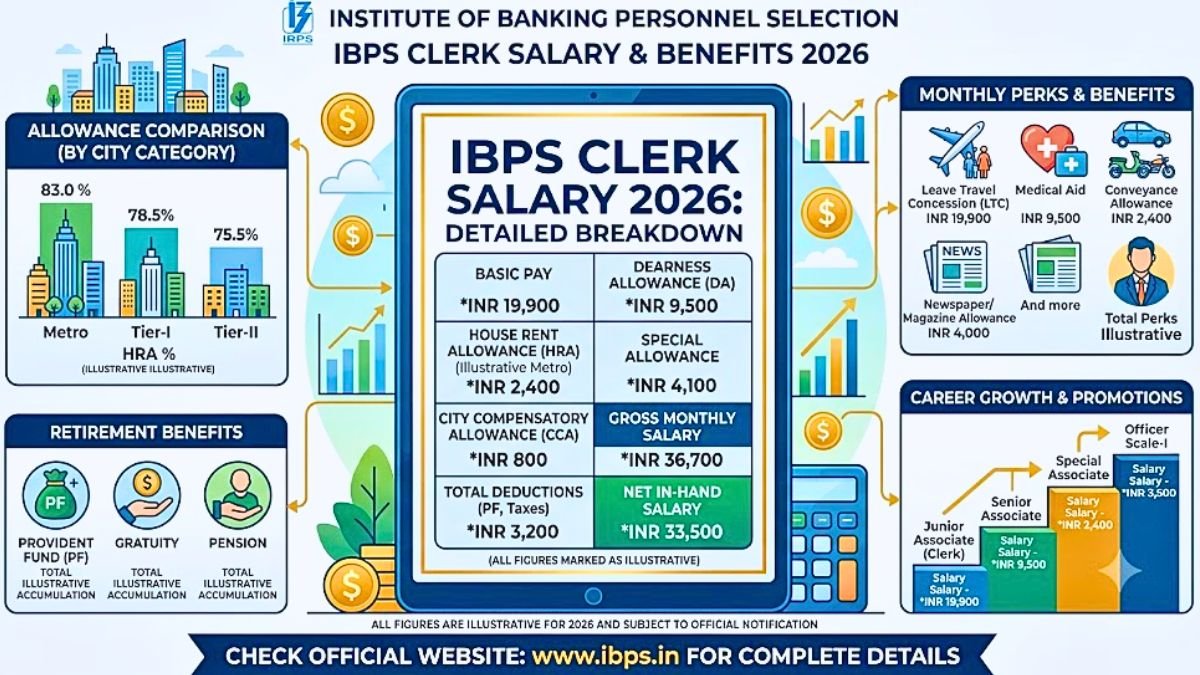
IBPS Clerk Salary 2026
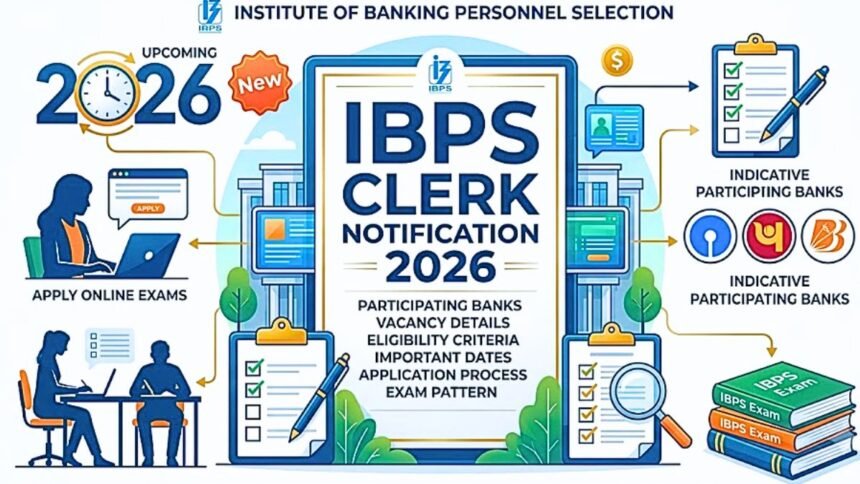
The Institute of Banking Personnel Selection (IBPS) is gearing up for another massive recruitment drive to fill clerical cadre vacancies across public sector banks in India. The IBPS Clerk 2026 recruitment cycle, officially designated as CRP CSA-XVI (Common Recruitment Process for Customer Service Associates, 16th edition), is one of the most awaited banking exams of the year, drawing lakhs of graduate aspirants who want a stable, well-paying career in the public banking sector. With the official notification expected shortly and the exam calendar already confirmed, this is the right time for candidates to understand every detail of the recruitment process — from eligibility and important dates to salary structure and long-term career growth.
What Is IBPS Clerk (CRP CSA-XVI)?
IBPS conducts the Common Recruitment Process every year to select candidates for clerical cadre positions across 11 participating public sector banks in India. While the exam was traditionally known as “IBPS Clerk,” the official designation of the post has been updated to Customer Service Associate (CSA). This means that if you come across the terms “IBPS CSA 2026” or “IBPS Customer Service Associate Recruitment,” they refer to the exact same examination that aspirants have historically known as IBPS Clerk.
This year’s cycle is being conducted for the 16th time, and hence it carries the designation CRP CSA-XVI, corresponding to vacancies for the financial year 2027-28. The role remains the same as before — successful candidates are placed in clerical positions across bank branches, where they handle customer-facing responsibilities such as account operations, cash transactions, passbook updates, and general banking support at the branch level.
Notification Release and Key Dates
According to the officially released IBPS Calendar 2026, the recruitment timeline for CRP CSA-XVI is expected to follow this schedule:
Notification Release: Expected in July–August 2026 on the official IBPS website (www.ibps.in)
Online Application Window: Tentatively set to begin in August 2026, and is likely to remain open for approximately three weeks
Preliminary Examination: Scheduled for 10th and 11th October 2026
Mains Examination: Scheduled for 27th December 2026
The IBPS exam calendar for 2026-27, which contains the tentative schedule for all major IBPS examinations, was released on 16 January 2026. This calendar has already been used as the reference point by most exam-preparation platforms to project the CRP CSA-XVI notification timeline. It’s worth noting that IBPS has already released the official notifications for two related exams — the IBPS PO and IBPS SO recruitment cycles — on 1st July 2026, which strongly indicates that the Clerk/CSA notification is likely to follow within the same broad window.
Candidates should treat these dates as provisional until the official notification is published, since IBPS occasionally revises timelines based on administrative requirements. Once released, the notification PDF will be the single authoritative source for all details, and aspirants are strongly advised to download and read it in full rather than relying solely on third-party summaries.
Participating Banks
IBPS Clerk recruitment is not conducted for a single bank. Instead, it functions as a common recruitment process through which candidates apply once and are subsequently allotted to one of 11 participating public sector banks based on merit and preference. This is one of the biggest advantages of the IBPS Clerk exam — a single application and exam attempt open the door to employment opportunities across a wide network of nationalized banks operating throughout the country. The specific list of participating banks, along with their state-wise vacancy distribution, will be announced in the official notification.
Educational Qualification
Candidates must hold a graduation degree in any discipline from a university recognized by the Government of India, or an equivalent qualification recognized by the Central Government. Candidates should also have a valid mark sheet or degree certificate confirming their graduation status as of the date of registration, along with the percentage of marks obtained.
In addition, candidates are typically required to demonstrate working knowledge of computers — this can be proven through a certificate, diploma, or degree in computer operations or computer language, or by having studied Computer Science/IT as a subject during school or college.
Age Limit
The age limit for IBPS Clerk 2026 is 20 to 28 years, with age relaxation applicable for candidates belonging to reserved categories such as SC/ST, OBC, PwBD, and ex-servicemen, as per government norms. Based on similar cycles, candidates would typically need to be born within a specific date range that IBPS will notify precisely in the official notification.
Nationality
Applicants must be citizens of India or fall under one of the categories recognized by the Government of India, such as a subject of Nepal or Bhutan, a Tibetan refugee who came to India before 1962 with the intention of permanently settling here, or a person of Indian origin who migrated from Pakistan, Myanmar, Sri Lanka, or select East African countries for permanent settlement in India.
Application Fee
Based on prior recruitment cycles, the application fee structure for IBPS Clerk 2026 is expected to be:
General/OBC/EWS candidates: ₹850
SC/ST/PwBD candidates: ₹175
The fee is payable online through the IBPS application portal at the time of registration, and candidates should keep proof of payment for future reference.
Selection Process
The IBPS Clerk selection process is a two-tier system, and unlike IBPS PO recruitment, it does not include a personal interview. This makes it a comparatively less stressful process for candidates who prefer written assessments over interview-based evaluation. The stages are:
Preliminary Examination — A qualifying-stage online test
Mains Examination — The decisive stage that determines final selection
Candidates must clear both the sectional and overall cut-offs in the Preliminary Exam to advance to Mains. Importantly, 100% weightage is given to the Mains examination score for preparing the final merit list — Prelims marks are not counted toward the final ranking; they only serve as a qualifying filter. Some banks may also conduct a Language Proficiency Test (LPT) for candidates allotted to states where knowledge of the regional language is a mandatory requirement, though this is typically a qualifying formality rather than a scoring component.
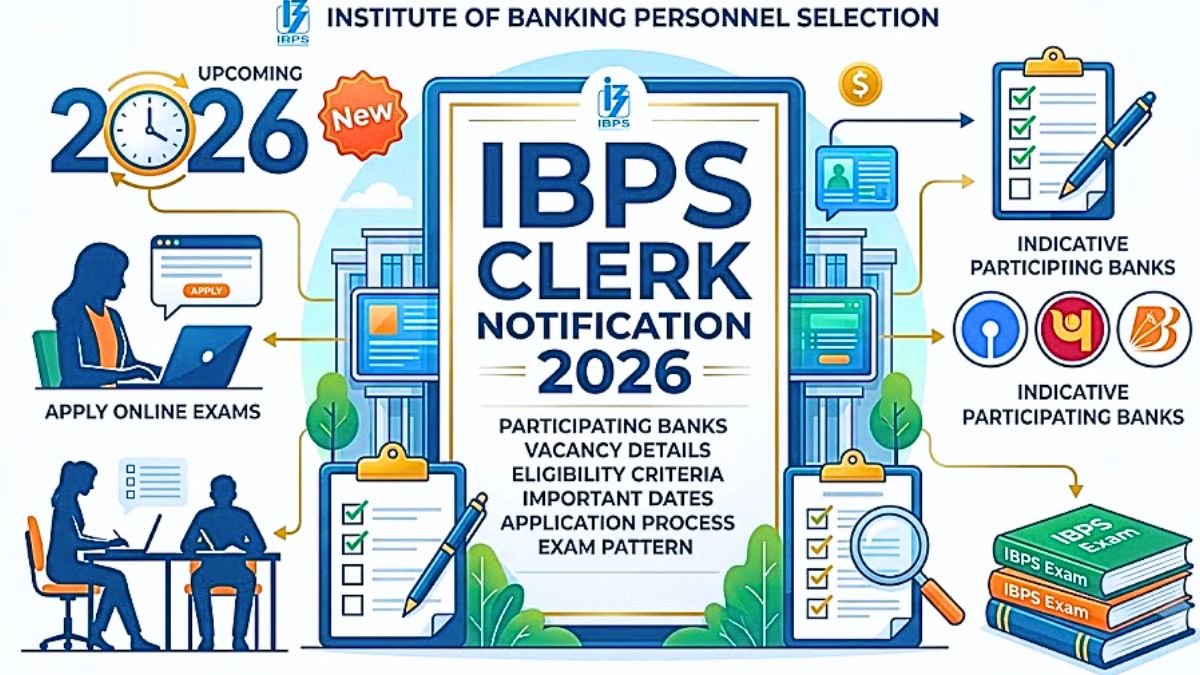
IBPS Clerk Notification 2026
Exam Pattern Overview
Both the Preliminary and Mains exams are conducted in computer-based (online) mode.
Preliminary Exam (Qualifying stage, 100 marks):
English Language
Numerical Ability
Reasoning Ability
Each section carries a fixed time limit of 20 minutes, and candidates must clear individual sectional cut-offs as well as an overall cut-off to qualify for Mains.
The Mains exam is comparatively tougher than Prelims and includes an additional General/Financial Awareness section that tests candidates on current affairs, banking awareness, and static general knowledge. In recent cycles, the number of Mains questions was reduced from 190 to 155, and the duration was shortened from 160 to 120 minutes, with the standalone Computer Aptitude section merged into Reasoning. These structural changes are expected to continue for the 2026 cycle as well.
Both exams carry negative marking, with one-fourth (0.25) of the marks allotted to a question deducted for every incorrect answer. The exam is conducted in English and Hindi, along with regional/local languages, giving candidates the flexibility to attempt the test in a language they are comfortable with, subject to availability in their chosen state.
IBPS Clerk 2026 Salary Structure
One of the biggest draws of IBPS Clerk recruitment is the stability and steady growth of the compensation package under the 12th Bipartite Settlement, which revised basic pay scales for clerical staff across public sector banks.
Salary Component
Approximate Value (Per Month)
Starting Basic Pay
₹24,050 (₹26,730 for graduates with 2 advance increments)
Gross Salary
₹40,000 to ₹45,000 (includes DA, HRA, Transport, and Special Allowances)
Deductions
Approx. ₹3,000 (NPS Contribution, Professional Tax, Union Fees)
In-Hand (Net) Salary
₹37,000 to ₹42,000 (varies slightly by metro, urban, or rural posting)
Graduate candidates are typically entitled to two advance increments in their basic pay, which pushes their starting basic pay slightly higher than that of non-graduate candidates — an important detail, since nearly all successful candidates in this exam are graduates, given the eligibility requirement.
Periodic Career Increments
The revised pay structure under the 12th Bipartite Settlement spans from ₹24,050 to ₹64,480 basic pay over a 20-year cycle, without requiring promotions. This means clerical staff receive automatic periodic increments purely based on tenure, in addition to any promotional growth they may achieve through internal bank examinations. The approximate progression looks like this:
Initial Pay: ₹24,050 basic
After 3 Years: ₹28,070 basic
After 6 Years: ₹33,020 basic
After 10 Years: ₹41,020 basic
Beyond the basic pay, employees also receive Dearness Allowance (DA), House Rent Allowance (HRA), Transport Allowance, and Special Allowances, along with other banking-sector benefits such as medical insurance, leave fare concessions, provident fund/NPS contributions, and pension benefits depending on the bank’s specific policy. Clerical staff in PSU banks also have a well-defined internal promotion pathway to become Special Assistants, Senior Special Assistants, and eventually officers through internal promotion exams — making this not just an entry-level job but a long-term career track.
Why IBPS Clerk 2026 Continues to Attract Lakhs of Aspirants
Every year, the IBPS Clerk exam remains one of the most competitive government job exams in India, and there are several reasons behind its enduring popularity:
Single exam, multiple bank opportunities: One application opens doors to positions across 11 different public sector banks
No interview stage: Selection is based entirely on written exams, which many aspirants find less intimidating than interview-based hiring processes
Job security and steady growth: Public sector bank jobs are known for stability, defined pay scales, and a transparent internal promotion structure
Nationwide vacancy spread: Vacancies are distributed across states and union territories, giving candidates from smaller towns and cities a genuine shot at securing a government banking job.
Reasonable eligibility bar: A basic graduation degree in any discipline is sufficient, making the exam accessible to candidates from diverse academic backgrounds
Preparation Strategy: What Aspirants Should Focus On Now
With the notification still pending but exam dates already confirmed, this is an ideal window for serious preparation. Aspirants should prioritise:
Building strong fundamentals in Quantitative Aptitude and Reasoning, since these sections carry significant weightage in both Prelims and Mains
Daily practice of English Language topics, including grammar, reading comprehension, and vocabulary
Following banking and financial current affairs consistently, since the Mains-only General/Financial Awareness section can be a significant differentiator in the final merit list
Attempting full-length mock tests under timed conditions to build speed and accuracy for the sectional time limits
Tracking the official IBPS website regularly for the notification release, as the application window is typically brief
Conclusion
The IBPS Clerk 2026 (CRP CSA-XVI) recruitment cycle represents a significant opportunity for graduate job seekers across India who are looking for a stable, respected, and financially secure career in the public banking sector. With Prelims confirmed for 10th and 11th October 2026 and Mains for 27th December 2026, candidates now have a clear runway to structure their preparation. While the official notification is still awaited, expected in July–August 2026, aspirants should use this time productively — strengthening core subjects, staying updated on banking current affairs, and closely monitoring the official IBPS website for further updates. Given the scale of vacancies typically released in this exam and the absence of an interview stage, thorough preparation for the written exams remains the single most important factor for success in this recruitment cycle.
Disclaimer: The dates, fee structure, and other details mentioned in this article are based on the IBPS Exam Calendar 2026-27 and historical recruitment trends. Candidates are advised to refer to the official IBPS notification once released on www.ibps.in for confirmed and complete information.