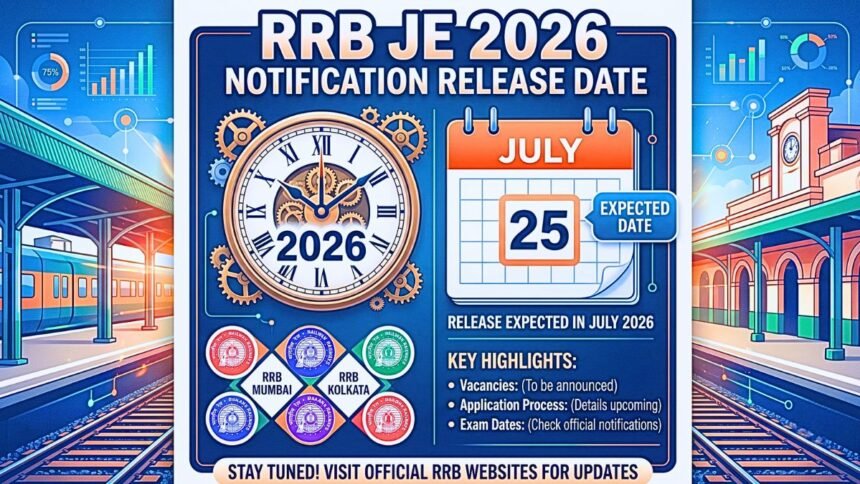
RRB JE 2026 Notification Release Date expected last week of July. Check 4,098 approved vacancies, eligibility, exam pattern & selection process details here.
The Railway Recruitment Board (RRB) has set the stage for one of the biggest technical recruitment drives of the year. On 1st July 2026, the Ministry of Railways officially approved 4,098 vacancies for the upcoming RRB JE Recruitment 2026 cycle, covering the posts of Junior Engineer (JE), Depot Material Superintendent (DMS), and Chemical & Metallurgical Assistant (CMA). This approval, issued under reference number E(MPP)/2026/24/4/JE-DMS-CMA, has generated massive excitement among engineering graduates and diploma holders across the country who have been waiting for a fresh Railway recruitment opportunity.
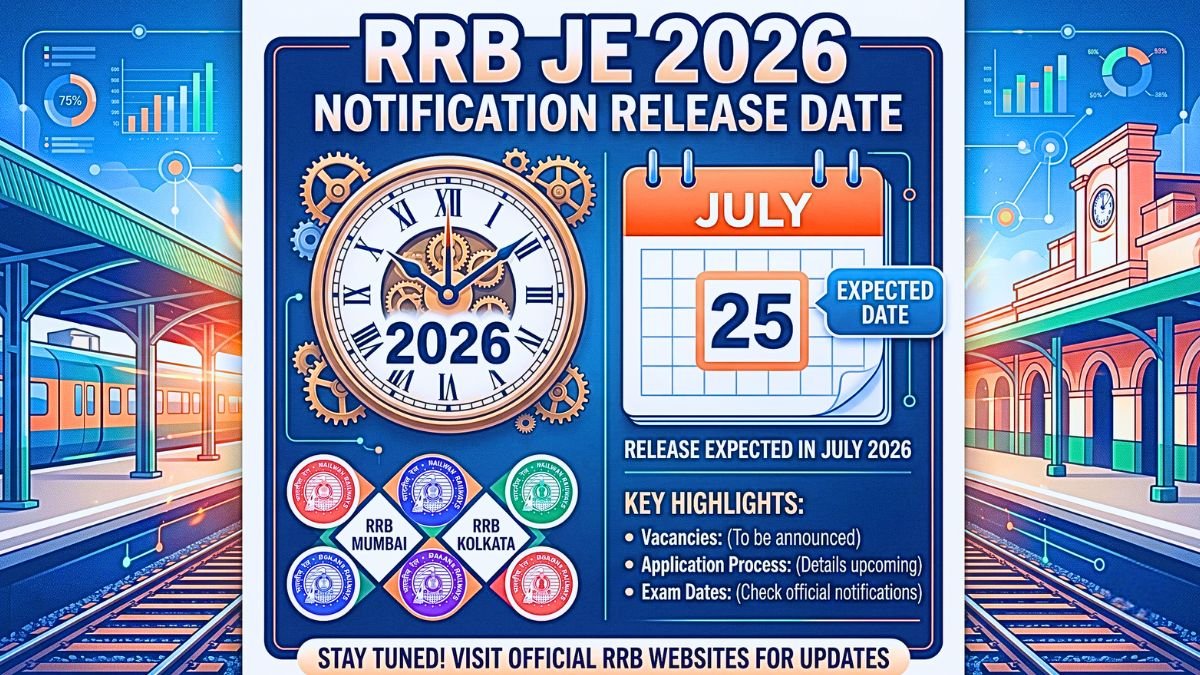
While the vacancy approval has been formally announced, aspirants should note that this is not yet the detailed recruitment notification. The complete Centralised Employment Notification (CEN) — which will carry the application dates, exam pattern, syllabus, fee structure, and zone-wise vacancy distribution — is expected to be released on the regional RRB websites in the last week of July 2026, with online applications tentatively scheduled to open in September 2026. Until then, this article breaks down everything currently known about the recruitment so candidates can begin their preparation with confidence.
RRB JE 2026 Release
What Is RRB JE Recruitment 2026?
The RRB JE exam is conducted periodically by the Railway Recruitment Boards under the Ministry of Railways to fill technical posts across Zonal Railways and Production Units. Unlike some other government exams, RRB JE is not an annual exercise — a new cycle is announced only when a sufficient number of vacancies accumulate across departments. The current approval of 4,098 posts makes this one of the largest JE recruitment drives in recent years, and it comes as welcome news for engineering aspirants who have been tracking vacancy trends since the last cycle.
The recruitment will fill technical roles in departments such as Civil Engineering, Mechanical Engineering, Electrical Engineering, Signal & Telecommunication, and Stores, spread across 35 distinct post categories.
Key Highlights and Vacancy Breakdown
Here are the essential highlights of the RRB JE 2026 vacancy approval:
Particulars
Details
Recruiting Body
Railway Recruitment Board (RRB), Ministry of Railways
Reference Number
E(MPP)/2026/24/4/JE-DMS-CMA
Total Approved Vacancies
4,098
Posts Included
Junior Engineer (JE), Depot Material Superintendent (DMS), Chemical & Metallurgical Assistant (CMA)
Number of Categories
35 post categories
Departments Covered
Civil, Mechanical, Electrical, Signal & Telecom, Track Machine, Bridge, Workshop, Rolling Stock, IT, and Stores
Out of the 35 categories, the Civil Engineering stream — particularly the JE (Permanent Way) category — is expected to account for the largest single share of vacancies, followed closely by the Mechanical and Electrical streams. The exact post-wise and zone-wise breakup will only be confirmed once the CEN is released, since the current notice covers only the Railway Board’s approval; the zone-wise indenting process through Zonal Railways and Production Units is still underway.
Understanding the Recruitment Process: From Approval to CEN
Candidates unfamiliar with the RRB recruitment lifecycle often confuse a “vacancy approval” with a full-fledged “notification.” Here is how the process actually unfolds:
Vacancy Approval by Railway Board: The Ministry of Railways sanctions the total number of posts required across departments. This is the stage that has just been completed with the 1st July 2026 notice.
Indenting Process via OIRMS: Zonal Railways and Production Units submit their final vacancy indents through the Online Indent and Requisition Management System (OIRMS).
Release of CEN: Once indenting is finalised, the Nodal RRB releases the detailed Centralised Employment Notification, which includes the application window, fee details, eligibility criteria, exam dates, and zone-wise vacancy distribution.
Online Application: Candidates apply through the official RRB portal within the specified window.
Examination and Selection: The recruitment then proceeds through CBT 1, CBT 2, Document Verification, and Medical Examination.
Right now, the process is between stages 1 and 2. This means aspirants have a genuine window of several weeks to strengthen their preparation before the formal application process begins.
Eligibility Criteria (Expected)
Although the final eligibility conditions will be confirmed in the CEN, based on the pattern followed in previous RRB JE cycles, candidates can expect the following broad criteria:
Educational Qualification: Candidates must hold a relevant Engineering Diploma or a B.E./B. A tech degree from a recognised institute, depending on the specific post and department applied for. Some CMA posts may also accept a B.Sc. with Physics and Chemistry as an alternate qualification. Freshers are eligible to apply, as no prior work experience is typically required for these posts.
Age Limit: The general age bracket is expected to be 18 to 33 years, calculated as of a reference date to be specified in the CEN (likely 1st July 2026 or a similar cut-off). As is standard practice, age relaxation will be applicable for reserved categories such as OBC, SC, ST, and PwBD candidates as per government norms, and additional relaxation is usually extended to Ex-Servicemen.
Candidates are strongly advised to wait for the official CEN before finalising their eligibility assumptions, since post-specific qualification requirements can vary between the JE, DMS, and CMA categories.
Selection Process and Exam Pattern
The RRB JE selection process is conducted in four distinct stages, and candidates must clear each stage to proceed to the next:
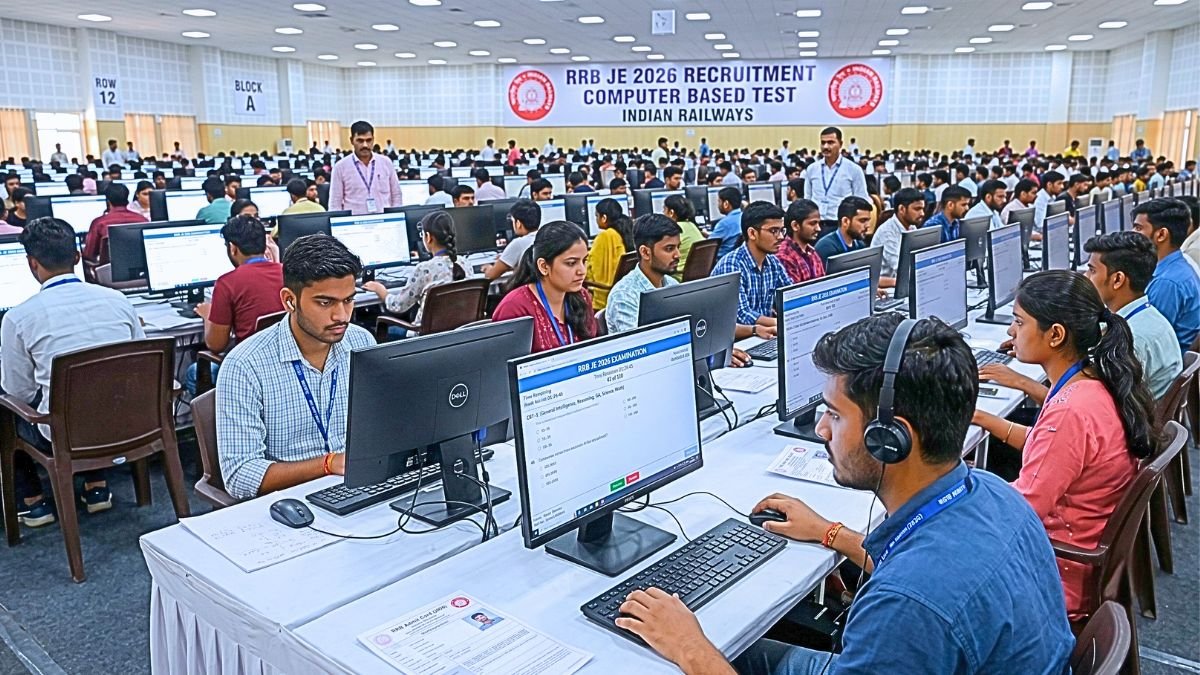
Stage 1: Computer-Based Test (CBT 1) – Screening Test
Duration: 90 minutes
Total Questions: 100
Subjects Covered: Mathematics, General Intelligence & Reasoning, General Awareness, and General Science
CBT 1 primarily functions as a screening round to shortlist a larger pool of candidates for the more technical second stage.
Focus Areas: This stage places heavy emphasis on core technical/engineering knowledge relevant to the candidate’s discipline, along with basic computer applications and general awareness of environment and science/chemistry concepts
CBT 2 is the stage that carries the most weight in determining a candidate’s final merit position, since it tests discipline-specific technical knowledge in depth.
Stage 3: Document Verification (DV)
Candidates who qualify both CBT stages are called for document verification, where original certificates related to educational qualification, age, category, and identity are checked.
Stage 4: Medical Examination (ME)
The final stage involves a medical fitness test to ensure candidates meet the physical and medical standards required for railway technical posts, which often involve fieldwork.
Important Note on Negative Marking: Both CBT stages carry negative marking of one-third (1/3) mark for every incorrect answer. This makes accuracy just as important as speed, and candidates should avoid guesswork on questions they are unsure of, since wrong answers can pull down the overall score significantly.
There is no interview round in the RRB JE selection process — final selection is based purely on performance in the two CBT stages combined with successful document verification and medical clearance.
Salary Structure and Pay Scale
One of the biggest draws of the RRB JE post is its attractive, stable government salary structure. Selected candidates will be placed under Pay Level 6 of the 7th Central Pay Commission (CPC).
Basic Pay: Starting at ₹35,400 per month
Approximate In-Hand Salary: Between ₹55,000 and ₹65,000 per month, inclusive of allowances such as Dearness Allowance (DA), House Rent Allowance (HRA), and Transport Allowance (TA), which vary based on posting location and city classification
In addition to the monthly salary, Railway JE employees are entitled to standard central government benefits, including medical facilities, pension benefits under the National Pension System (NPS), free or concessional railway travel passes, and periodic increments as per pay commission norms. The job also offers strong long-term career progression, with promotional avenues to Senior Section Engineer and higher technical grades over the course of a career in Indian Railways.
Why This Recruitment Matters for Engineering Aspirants
For lakhs of engineering diploma and degree holders across India, RRB JE remains one of the most sought-after government job opportunities due to its combination of technical work, job security, and respectable starting pay. With 4,098 vacancies approved — a notably higher number compared to some recent cycles — this recruitment drive represents a significant opportunity, especially for candidates from Civil, Mechanical, Electrical, and Signal & Telecommunication backgrounds.
The scale of this recruitment also means competition is expected to be intense, given the sheer number of engineering graduates who apply for railway technical posts each year. Candidates are encouraged to use the coming weeks productively — before the CEN and application window open — to revise fundamental engineering concepts, strengthen reasoning and general awareness sections, and become familiar with the previous years’ exam pattern and cut-off trends.
RRB JE 2026 Notification Release Date
What Should Candidates Do Right Now?
Since the detailed notification is still awaited, candidates preparing for RRB JE 2026 should focus on the following action points:
Keep checking the official RRB regional websites and the RRB Chandigarh portal regularly, as the CEN release could happen anytime from the last week of July 2026 onwards.
Begin revising core technical subjects relevant to your engineering discipline, since CBT 2 places heavy weight on technical knowledge.
Strengthen General Awareness and Reasoning, as these form a significant chunk of CBT 1 and can make the difference in clearing the screening stage.
Practice previous years’ RRB JE question papers to understand the difficulty level and question distribution across sections.
Keep educational and category certificates ready, since document verification is a mandatory stage after CBT 2.
Frequently Asked Questions (FAQs)
Q1. How many vacancies have been approved for RRB JE Recruitment 2026?
A total of 4,098 vacancies have been approved for Junior Engineer, Depot Material Superintendent, and Chemical & Metallurgical Assistant posts.
Q2. When will the RRB JE 2026 detailed notification (CEN) be released?
The detailed CEN is expected to be issued on the regional RRB websites in the last week of July 2026.
Q3. When will the online application process start for RRB JE 2026?
Online applications are tentatively expected to begin in September 2026, though the exact dates will be confirmed in the CEN.
Q4. What is the age limit for RRB JE Recruitment 2026?
The expected age limit is 18 to 33 years, with standard age relaxation applicable for reserved categories as per government rules.
Q5. What is the selection process for RRB JE 2026?
Selection involves four stages: CBT 1 (screening test), CBT 2 (technical and merit test), Document Verification, and Medical Examination.
Q6. Is there negative marking in the RRB JE exam?
Yes, both CBT 1 and CBT 2 carry a negative marking of 1/3 mark for every incorrect answer.
Q7. What is the expected salary for RRB JE selected candidates?
Selected candidates will be placed at Pay Level 6 (7th CPC), with a basic pay of ₹35,400 and an approximate in-hand monthly salary of ₹55,000 to ₹65,000, including allowances.
Q8. Is there an interview round in RRB JE Recruitment?
No, there is no interview round. Final selection is based on CBT performance, document verification, and medical fitness.