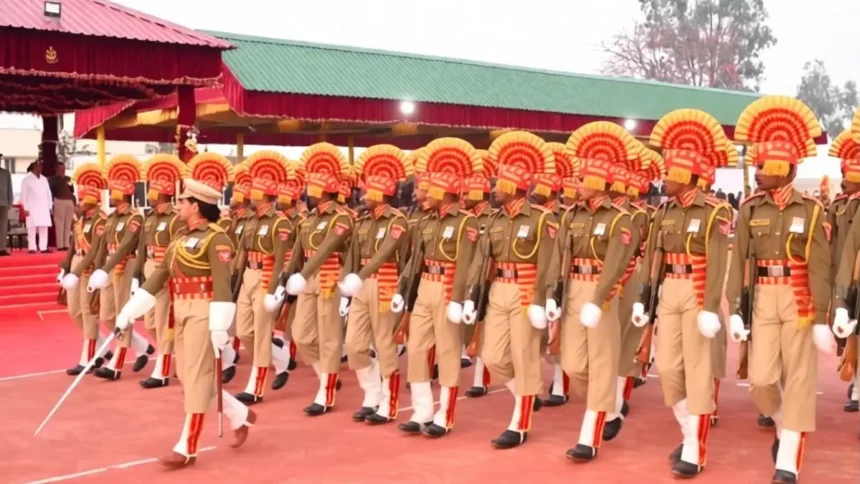
Preparing for SSB Head Constable Syllabus 2026? Get the complete syllabus breakdown — Reasoning, Quantitative Aptitude, GK, Language & Technical subjects along with exam pattern and expert tips to score high in the CBT on July 7, 2026
The Sashastra Seema Bal (SSB), one of India’s premier border-guarding forces, has officially announced its 2026 recruitment drive for the post of Head Constable (Ministerial). With the written Computer Based Test (CBT) scheduled for July 7, 2026, thousands of aspirants across the country are gearing up for one of the most competitive examinations in the paramilitary sector. This article provides a thorough, in-depth analysis of the SSB Head Constable Exam 2026 — covering the official exam date, eligibility criteria, exam pattern, detailed subject-wise syllabus, and actionable preparation strategies to help candidates maximize their chances of success.
Exam Pattern Overview
- Duration: 3 Hours.
- Format: Objective type.
- Total: 150 Questions / 150 Marks.
- Negative Marking: Generally, no negative marking.
- Structure:
- Part 1 (50 Marks): General Knowledge, Mathematics, Reasoning, and choice of English or Hindi.
- Part 2 (100 Marks): Technical/Trade specific (e.g., PCM for Communication, trade-specific skills for Electrician/Veterinary).
- Note: For Head Constable Ministerial, the paper is 100 marks split across language, math, reasoning, and GK.
Detailed Syllabus
| Section | Key Topics |
| Reasoning | Analogies, Coding-Decoding, Blood Relations, Syllogism, Seating Arrangement, Direction Sense, Figure Series, Venn Diagrams. |
| Mathematics | Number Systems, Simplification, HCF & LCM, Average, Percentage, Profit & Loss, Interest, Ages, Time & Work, Speed & Distance, Geometry, Algebra, Data Interpretation. |
| GK & Awareness | National/International Current Affairs, Indian History, Geography, Polity, Constitution, General Science, Environmental Ecology. |
| Language (Opt) | English: Grammar (Errors, Blanks, Synonyms/Antonyms, Idioms, Active/Passive, Direct/Indirect). Hindi: व्याकरण (वर्तनी, मुहावरे, विलोम/पर्यायवाची, वाक्य शुद्धि, लिंग/वचन). |
| Technical/Trade | Communication: 12th level Physics, Chemistry, Math (PCM), Basic Electronics, and Computer Science. Others: Specific trade certifications and operational guidelines. |
Whether you are a first-time applicant or a returning candidate, understanding the nuances of the SSB Head Constable recruitment process is critical. The selection process is structured and multi-staged, and only those who clear every phase will earn a coveted position in this esteemed organization that guards India’s borders with Nepal and Bhutan.
Overview of SSB and the Head Constable Post
The Sashastra Seema Bal (SSB) is a Central Armed Police Force (CAPF) operating under the Ministry of Home Affairs, Government of India. Established with the mandate to guard India’s borders with Nepal and Bhutan, the SSB also plays a vital role in internal security, counter-insurgency operations, and disaster management. With a vast network of battalions deployed across some of the most challenging terrains in the country, the SSB requires not just frontline personnel but also a robust administrative backbone to keep operations running smoothly.
The Head Constable (Ministerial) post is primarily an administrative and clerical role within the SSB. Individuals selected for this post are responsible for maintaining official records, handling correspondence, managing files, and assisting in day-to-day administrative operations of SSB battalions and units. It is a Group C, Non-Gazetted post that offers job security, competitive pay, government perks, and a defined career progression path.
In addition to the Ministerial post, the 2026 recruitment notification also covers specialized trades including Head Constable (Communication), Head Constable (Electrician), Head Constable (Steward), and Head Constable (Veterinary). However, the written exam dates for these specialized trade categories are yet to be officially announced, and candidates are advised to regularly check the official SSB or SSC websites for updates.
Important Exam Dates and Eligibility Criteria
The official written examination date for SSB Head Constable (Ministerial) has been confirmed as July 7, 2026. This Computer Based Test (CBT) is a critical stage in the selection process and is open only to those candidates who have successfully cleared the earlier selection stages — namely, the Physical Efficiency Test (PET) and the Physical Standard Test (PST).
To be eligible for the CBT, candidates must have passed both of these physical stages. The PET tests physical stamina through events like running, long jump, and high jump. The PST measures height, weight, and chest measurements against prescribed standards that vary slightly by candidate category and state of origin.
General eligibility requirements include holding a 12th standard (Intermediate) pass certificate from a recognized board. Candidates should fall within the prescribed age brackets, typically between 18 and 25 years, with relaxations for SC/ST/OBC, and Ex-Servicemen as per government norms. They must also be Indian citizens and meet character, medical fitness, and domicile requirements as specified in the official notification.
For the specialized trade categories — Communication, Electrician, Steward, and Veterinary — the general academic eligibility may additionally require trade-specific certification or diplomas at the ITI level or equivalent. Candidates applying to these posts must verify their eligibility against the specific requirements mentioned in the official recruitment advertisement.
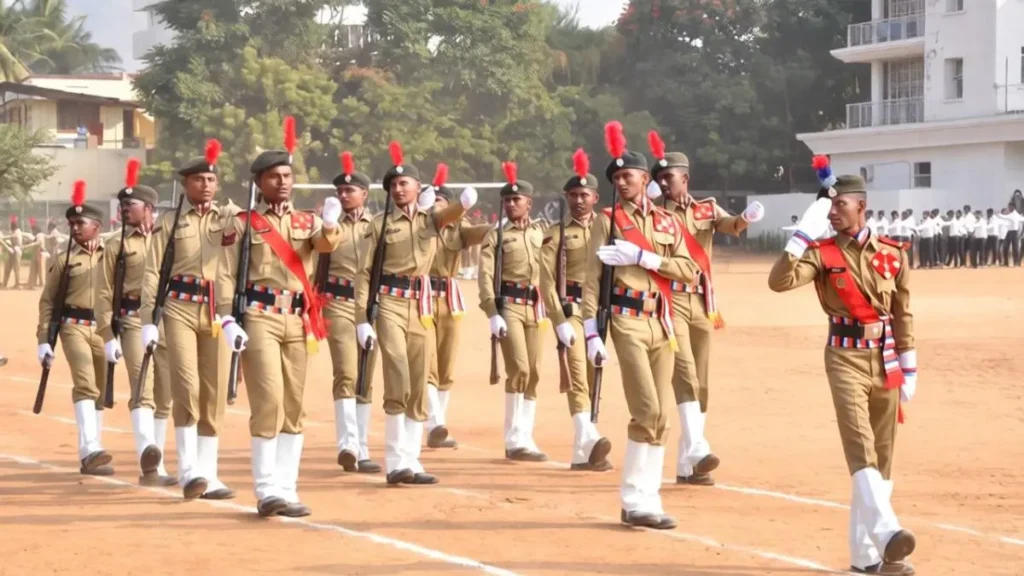
SSB Head Constable Exam Pattern: Structure and Scoring
The Computer Based Test is a 3-hour objective-type examination. The exam consists of 150 questions carrying a total of 150 marks. One of the most candidate-friendly features of this exam is that there is no negative marking, which encourages candidates to attempt all questions without fear of penalty for wrong answers.
The exam is divided into two parts:
Part 1 — General Subjects (50 Questions / 50 Marks)
This section tests candidates on four core academic areas: General Knowledge, Mathematics, Reasoning, and English or Hindi (the candidate’s choice). Each area is equally weighted within this section, making it essential to maintain balanced preparation across all domains. This section is common to all Head Constable posts regardless of the trade applied for.
Part 2 — Technical/Trade Specific (100 Questions / 100 Marks)
This section varies based on the trade applied for. For Head Constable (Communication), it includes Physics, Chemistry, Mathematics, and basic Electronics and Computer Science. For other trades like Electrician, Steward, or Veterinary, the questions are aligned with relevant trade-specific knowledge and competencies.
For the Head Constable (Ministerial) post specifically, the exam consists of a single 100-mark paper evenly split across four core domains: language (English or Hindi), Mathematics, Reasoning, and General Knowledge. There is no separate technical trade paper for Ministerial candidates, making it more accessible to candidates from a variety of academic backgrounds.
The CBT is conducted online at designated exam centers, and candidates are allotted specific time slots for their examination. It is important to read the official admit card instructions carefully before the exam day.
Subject-Wise Detailed Syllabus
Understanding the detailed syllabus is the first and most important step in structured preparation. Below is a comprehensive breakdown of each subject covered in the SSB Head Constable 2026 examination.
4.1 General Intelligence and Reasoning
This section evaluates a candidate’s cognitive and analytical abilities. It comprises two main categories:
Verbal Reasoning includes Analogies, Coding-Decoding, Blood Relations, Syllogism, Seating Arrangement (both Linear and Circular), and Direction Sense. These questions measure a candidate’s ability to identify patterns and relationships in verbal or symbolic information. Blood Relations and Coding-Decoding are consistently high-yield topics in this section across all government competitive exams.
Non-Verbal Reasoning covers Figure Series Completion, Venn Diagrams, Classification, and Odd One Out. These questions test the ability to process visual and abstract information logically, without relying on language proficiency. Candidates who practice with diagrammatic puzzles and pattern-recognition exercises tend to perform much better in this section.
To score well in Reasoning, candidates should practice 30 to 40 questions daily, focusing on both speed and accuracy. Previous year SSC-GD, SSC CHSL, and CAPF reasoning papers are excellent practice resources.
4.2 Quantitative Aptitude / Mathematics
Mathematics in the SSB CBT is divided into two sub-sections:
Arithmetic topics include Number Systems, Simplification, HCF and LCM, Averages, Percentages, Profit and Loss, Simple and Compound Interest, and Problems on Ages. These are foundational topics that appear in virtually every government competitive examination and can be mastered through consistent formula memorization and regular practice.
Advanced Math and Data covers Time and Work, Time, Speed and Distance, Mensuration, Basic Algebra, Geometry, Trigonometry, and Data Interpretation including Bar graphs and Pie charts. Data Interpretation, in particular, is increasingly prominent in modern CBT exams. Candidates should be comfortable reading graphs quickly and performing calculations under time pressure.
The key to performing well in Mathematics is not just conceptual understanding but also calculation speed. Practicing mental math, learning shortcut techniques, and solving questions within time limits should form a core part of daily practice.
4.3 General Knowledge and Awareness
General Knowledge is a broad section that blends both current awareness and static knowledge:
Current Affairs focuses on national and international events, sports achievements and tournaments, prestigious awards such as Padma Awards, Bharat Ratna, and Nobel Prizes, and prominent personalities in the news. Staying updated with daily news through a reputable newspaper or a monthly current affairs digest is the most effective strategy here.
Static GK covers the History of India and the Indian National Movement, Physical and Economic Geography of India and the world, Indian Polity and Constitution (including fundamental rights, directive principles, and constitutional bodies), General Science, and Environmental Ecology. These topics are timeless and can be effectively prepared through standard NCERT textbooks from Classes 6 to 10. Lucent’s General Knowledge book is also widely regarded as a one-stop reference for Static GK.
Candidates should aim to revise GK topics regularly since this subject requires retention over a long period rather than last-minute cramming.
4.4 General English / General Hindi (Optional Language Section)
Candidates may opt for either English or Hindi based on their comfort and language proficiency. Both options test language competency at a similar level of difficulty.
English topics include Spotting Errors, Fill in the Blanks, Synonyms and Antonyms, Idioms and Phrases, One-word Substitution, Sentence Improvement, Active and Passive Voice, and Direct and Indirect Speech. Candidates are expected to have a working knowledge of English grammar at the intermediate school level.
Hindi topics include Vartani ki Samanya Ashuddhiyan (Spelling Errors), Muhavare aur Lokoktiyan (Idioms and Proverbs), Vilom aur Paryayvachi Shabd (Antonyms and Synonyms), Vakyon ka Shuddh Roop (Sentence Correction), Ling Parivartan (Gender), and Vachan (Number). Hindi-medium candidates who have studied the language formally through Class 10 and above will find this section manageable with regular revision.
The language section rewards consistency. Building a habit of reading and identifying grammatical constructs daily — whether in English or Hindi — significantly improves performance.
4.5 Technical/Trade Syllabus (Part 2, Where Applicable)
For candidates applying to trade-specific Head Constable posts, Part 2 is where the bulk of the marks lie.
HC Communication requires Intermediate (12th standard) level Physics, Chemistry, and Mathematics alongside basic Electronics and Computer Science concepts. Topics include digital circuits, communication systems, basic networking concepts, and semiconductor devices. Candidates from a Science or Engineering background will find this section more accessible, while others may need to invest significant additional time.
Other Trades — Electrician, Veterinary, Medical Cadre, and Steward — focus on fundamental trade-specific certifications, technical operations, and safety guidelines relevant to each respective domain. Electrician candidates, for instance, are expected to know wiring systems, electrical safety, and basic circuit theory. Veterinary candidates must demonstrate knowledge of animal husbandry and basic veterinary care.
Selection Process: End-to-End Overview
The SSB Head Constable selection process is multi-tiered and designed to evaluate candidates on physical fitness, intellectual ability, and overall suitability for service. It typically proceeds through the following stages:
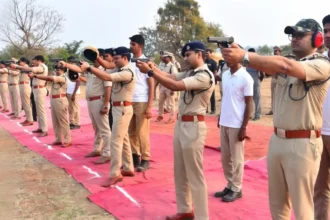
Stage 1 — Physical Efficiency Test (PET): Candidates demonstrate physical endurance through events such as a 1.6 km timed run, long jump, and high jump. Only those meeting the qualifying standards proceed to the next stage.
Stage 2 — Physical Standard Test (PST): Measurement of height, weight, and chest (for male candidates) against prescribed norms. These standards vary slightly by category and state of domicile.
Stage 3 — Computer Based Test (CBT): The 150-mark written test on July 7, 2026. This is the primary academic evaluation stage, and a candidate’s performance here directly determines their ranking in the merit list.
Stage 4 — Skill Test / Trade Test: For Ministerial posts, a typing and computer proficiency test may be conducted. For trade posts, practical assessments are used to evaluate hands-on competency in the relevant field.
Stage 5 — Document Verification and Medical Examination: Final shortlisted candidates undergo scrutiny of original documents and a comprehensive medical examination to confirm their fitness for active service in the SSB.
Strategic Preparation Plan
With the CBT exam approaching, a smart, focused, and consistent preparation strategy is essential. Below is a structured approach to help candidates maximize their scores.
Understand the Weightage: Part 2 carries 100 marks versus 50 for Part 1. If applying for a trade-specific post, allocate preparation time proportionally — but never neglect the general subjects, as they form the foundation.
Build a Weekly Study Schedule: Divide subjects across the week. Dedicate Monday and Tuesday to Mathematics, Wednesday to Reasoning, Thursday to General Knowledge, Friday to Language, Saturday to the trade/technical subject, and Sunday entirely to a full-length mock test and revision.
Leverage the No-Negative-Marking Advantage: Attempt every single question. Even eliminating two obviously wrong options from a four-choice question and guessing gives you a 50% chance of being correct. Train yourself to attempt all 150 questions well within the 3-hour limit.
Practice with Mock Tests: Taking timed, full-length mock tests weekly is non-negotiable. Mock tests build exam temperament, reveal weak areas, and sharpen time management — all critical factors on exam day. Analyze every mistake after each test rather than just checking your score.
Recommended Resources: For Mathematics, R.S. Aggarwal’s Quantitative Aptitude is the gold standard. For Reasoning, both R.S. Aggarwal’s Verbal and Non-Verbal Reasoning and MK Pandey’s Analytical Reasoning are highly effective. For GK, rely on Lucent’s General Knowledge combined with a monthly current affairs magazine. For English, SP Bakshi’s Objective General English is widely trusted. For Hindi, Lucent’s Samanya Hindi alongside previous SSC papers works well.
Exam Day Tips
Your performance on July 7, 2026 will depend greatly on how rested, organized, and calm you are when you sit down at the terminal. Arrive at the center at least 45 minutes early to allow time for check-in and biometric verification. Carry your admit card, a valid photo ID (Aadhaar, Voter ID, or Passport), and passport-sized photographs.
Begin the exam with your strongest subject to build early confidence and momentum. Do not spend more than 90 seconds on any single question — mark it for review and move on. Return to flagged questions once you have completed the rest. Since there is no negative marking, ensure every single question is answered before time expires.
Career Prospects After Selection
A successful selection as SSB Head Constable opens the door to a stable, rewarding, and respected government career. Selected candidates are placed under the 7th Pay Commission pay matrix at Level 4, with a starting basic pay of approximately Rs. 25,500 per month, supplemented by Dearness Allowance, House Rent Allowance, transport allowances, and other government benefits. Over time, the total compensation package is highly competitive with private sector equivalents at the same educational level.
With experience and performance in departmental examinations, Head Constables can be promoted to Assistant Sub-Inspector (ASI), Sub-Inspector (SI), Inspector, and higher ranks through the established internal promotion hierarchy. Additionally, high-performing individuals may be selected for specialized training programs and inter-CAPF opportunities.
Conclusion: Your Path Forward
The SSB Head Constable 2026 exam represents a significant and meaningful opportunity for young aspirants seeking a secure, respected, and service-oriented career in India’s paramilitary forces. The examination is well-structured, transparent, and assesses candidates across a broad range of general and specialized knowledge areas.
With the written CBT set for July 7, 2026, candidates who have cleared the PET and PST stages must now focus exclusively and intensively on academic preparation. The syllabus is clearly defined and substantially overlaps with other government competitive examinations, making it accessible to candidates already preparing for SSC, UPSC, or state-level exams.
Success requires discipline, consistency, and smart strategy. Understand the syllabus thoroughly, build subject-wise competence, practice daily with timed exercises and mock tests, and make full use of the no-negative-marking policy on exam day. With the right approach and unwavering dedication, clearing the SSB Head Constable CBT 2026 is well within reach for any serious aspirant.
Best of luck to every candidate appearing for this examination. Your preparation today will define your career tomorrow.
Footnotes
https://recruitment.ssb.gov.in
References
https://recruitment.ssb.gov.in/
External links
SSB Head Constable Recruitment 2026